Peptides, From First Principles
The chemistry is settled and genuinely elegant. The marketplace built on top of it is where the evidence stops being uniform — and the word "peptide" does a lot of work hiding that.
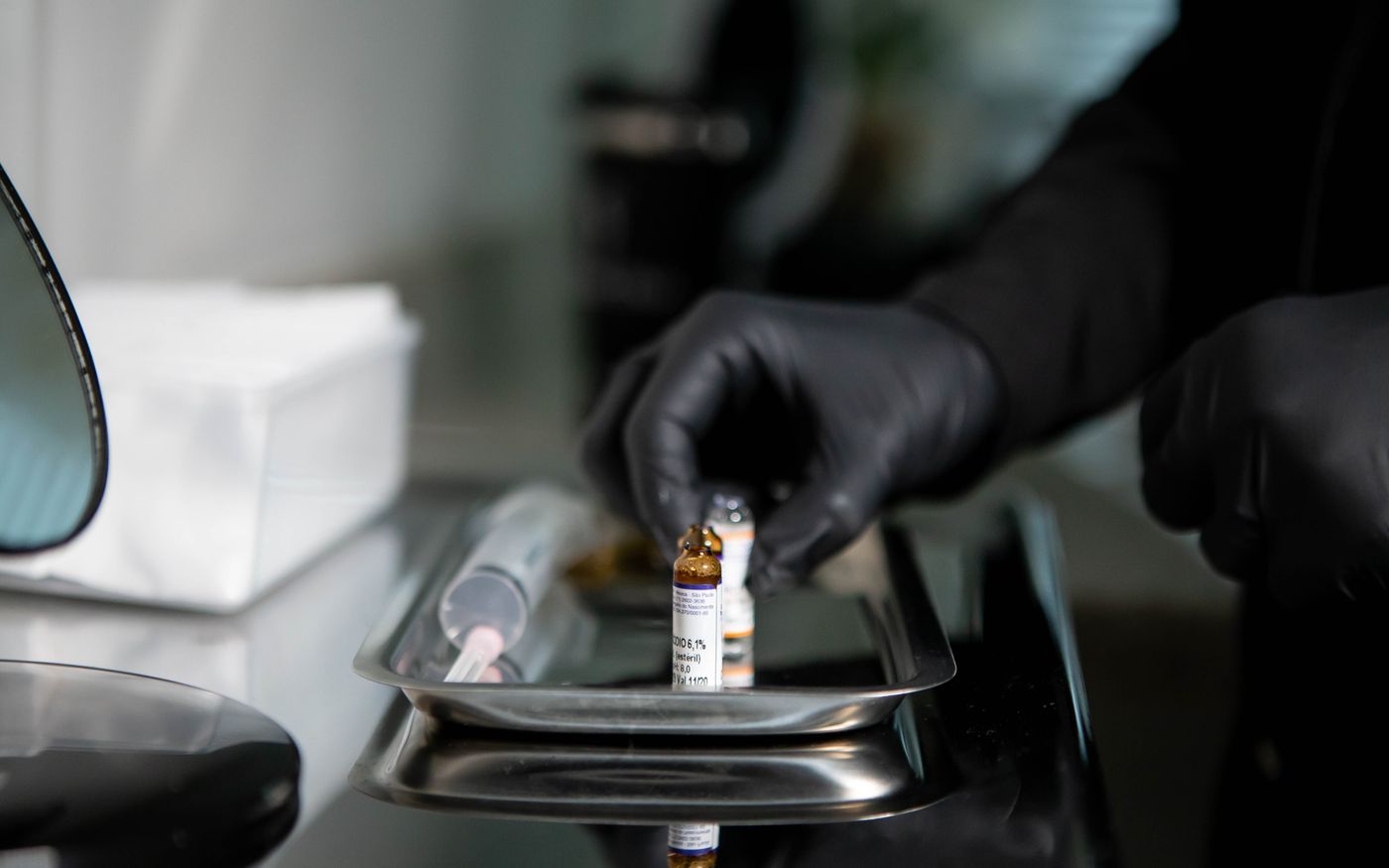
"Peptide" has become a category label the way "supplement" did twenty years ago: a single word covering a drug with tens of thousands of trial participants behind it and a powder with none, discussed in the same breath, at the same level of confidence.
The underlying biochemistry is not controversial. It is well characterised, it is elegant, and it is worth understanding properly — because once you do, the right question to ask about any specific compound becomes obvious.
What a peptide is
Amino acids are the units proteins are built from. Link them with peptide bonds — an amide bond between the carboxyl group of one and the amino group of the next — and you get a chain. Short chains are peptides. Long chains are proteins.
The dividing line is usually quoted as fifty residues, and it is worth knowing that this is a convention rather than a fact about chemistry. Nothing changes at residue fifty-one. Insulin is the useful illustration: at 51 amino acids across two chains it sits just past the line, is routinely called a peptide hormone anyway, and nobody is wrong.
Your body manufactures thousands of these, and they are involved in nearly every process worth naming. Insulin regulates glucose. Glucagon opposes it. Oxytocin and vasopressin, at nine residues each and differing by only two, do substantially different jobs. Length is not what determines function — sequence is, because sequence determines shape.
Peptides are not steroids, and the difference is mechanical
This is the most useful distinction in the field, and it is not a matter of degree.
Steroids are lipophilic. Testosterone and cortisol pass straight through the cell membrane, bind receptors inside the cell, and the resulting complex acts directly on gene transcription. When you take exogenous testosterone you are adding the hormone itself to your system. The dose is the effect.
Peptides are hydrophilic and generally cannot cross the membrane at all. They bind receptors on the cell surface and pass a message inward. They are instructions, not payloads.
How the signal actually gets in
A peptide's folded shape is complementary to a binding site on its receptor. Binding changes the receptor's conformation, and that change is the message.
Many peptide hormones signal through G protein-coupled receptors. The receptor activates an associated G protein, which drives production of a second messenger such as cyclic AMP, which activates enzymes, which act on further targets. Each step multiplies: one binding event can produce a great many downstream molecules. That amplification cascade is why peptides are active at doses measured in micrograms.
You will often read that peptide receptors are GPCRs "with few exceptions." That generalisation is useful, but it is looser than it sounds, and the exceptions are not obscure:
- Insulin and IGF-1 signal through receptor tyrosine kinases, not GPCRs. The receptor is itself an enzyme, and it phosphorylates its own targets.
- Growth hormone, leptin and the interleukins use cytokine receptors, which recruit JAK kinases and signal through the STAT pathway.
So the most famous peptide hormone in medicine is an exception to the rule usually stated about peptide hormones. Worth knowing if you want to reason about mechanism rather than recite it.
Why almost all of them are injected
Your digestive tract is specifically built to destroy these molecules. Pepsin in the stomach, then trypsin and chymotrypsin in the small intestine, cleave peptide bonds; that is their function. Anything surviving that faces an intestinal wall not designed to pass large hydrophilic molecules, and then first-pass metabolism in the liver.
Swallow most peptides and you have eaten a small, expensive quantity of amino acids.
Subcutaneous or intramuscular administration bypasses all of it. The exceptions that do work orally or nasally are exceptions by engineering, not by luck:
- Oral semaglutide is co-formulated with SNAC, an absorption enhancer that locally raises gastric pH and aids permeation. Bioavailability is still around one percent, which is why the oral dose is so much larger than the injected one.
- Desmopressin is a modified vasopressin analogue, deliberately altered to resist enzymatic degradation.
- Cyclosporine is cyclic, which protects it from the exopeptidases that chew linear chains from the ends.
If a product claims oral activity for a peptide carrying no such modification, that claim is the first thing to check.
The part that gets flattened
Here is where the single word "peptide" does the most damage, because it spans at least three very different regulatory and evidentiary situations.
Approved medicines with large trial bases. Semaglutide and tirzepatide have been through extensive phase 3 programmes with tens of thousands of participants and published cardiovascular outcome data. Bremelanotide was approved by the FDA in 2019 for hypoactive sexual desire disorder in premenopausal women. Teriparatide, desmopressin, liraglutide and octreotide are all approved drugs. Whatever else is true of these, they have been tested.
Investigational compounds. Retatrutide is in phase 3. Early results have been striking. It is approved nowhere, its long-term safety profile is not established, and "promising phase 2 data" describes an open question rather than a finding.
Compounds with no approved human use at all. BPC-157, TB-500, CJC-1295, ipamorelin and AOD-9604 sit here. There are no published randomised controlled trials of BPC-157 in humans — that literature is rodent work and cell culture. In 2023 the FDA placed it in Category 2 of its 503A bulk substances list, the category for substances with significant safety concerns for compounding. AOD-9604 failed its obesity trials. Semax and Selank are approved in Russia and nowhere else.
The gap between the first group and the third is not a matter of degree. It is the difference between tens of thousands of randomised participants and zero.
What to expect, honestly
Peptides are signalling molecules. They modulate systems you already have. That framing sets the realistic ceiling on all of them.
If training is inconsistent, sleep is short and protein intake is low, a compound whose entire mechanism is "amplify an existing signal" has very little to amplify. This is not a motivational point, it is a mechanistic one.
Specifically:
- Healing compounds cannot repair damage that is structural. A tear requiring surgical repair requires surgical repair.
- Growth hormone secretagogues act through IGF-1 and are constrained by your own axis. They do not produce anabolic-steroid effects, and anyone implying otherwise is describing a different drug class.
- Appetite suppression from GLP-1 agonists is real and large. It is also not a substitute for the eating patterns you will need afterwards — weight regain after discontinuation is one of the better-documented findings in that literature.
- Most require repeated injection over months, with real technique, storage and sterility demands.
If you are considering any of this
The approved compounds are prescribable, and a clinician can weigh them against your history, your medications and your bloodwork in a way no article can. That route also gets you a regulated product with a known dose and a known purity — which, given that everything in this category is injected, is not a small consideration.
For the unapproved compounds, the honest summary is that the human evidence does not exist yet. That is not the same as saying they do not work. It means nobody knows, including the people selling them, and that you would be the experiment.
We will cover the individual categories — GLP-1 agonists, growth hormone secretagogues, the healing compounds, the cognitive ones — in separate pieces, with the evidence for each laid out as it actually stands.
Disclosure: Biohacker Life is published by the team behind Nalu Labs, which sells in this category. That is a commercial interest and you should weigh our coverage accordingly. Our editorial approach here is the one we apply everywhere else on this site: name the evidence, name the gaps, and say which is which.
General information about biochemistry and drug regulation, not medical advice. Nothing here is a recommendation to obtain or self-administer any compound. Injected substances carry infection, contamination and dosing risks; several compounds named above are prescription-only or unapproved, and legality varies by jurisdiction. Many are also prohibited in competitive sport under the WADA code. Talk to a qualified clinician.