Reconstitution: Which Rules Are Real
The standard guidance is a mix of genuine sterile compounding practice and folklore repeated until it hardened. The two are worth separating, because only one of them prevents infections.

Reconstitution advice circulates as a fixed list of commandments — never shake, always aim at the glass, clear means good — delivered with equal weight and equal confidence.
Some of those rules come straight out of pharmacy compounding practice and are worth following exactly. Some are reasonable practice wrapped in an overstated rationale. And at least one is actively misleading, because it teaches people to treat a visual check as a safety test.
What freeze-drying actually does
Lyophilisation removes water by sublimation: the product is frozen, then held under vacuum so ice passes directly to vapour without a liquid phase. What remains is a dry cake.
Water is what makes peptides fragile. Remove it and you remove the medium for hydrolysis and for microbial growth, which is why lyophilised material tolerates shipping without a cold chain.
One correction to the usual framing, though. "Stable at room temperature" describes a shipping window, not a storage plan. Most manufacturers still specify refrigerated or frozen storage for the dry powder over any meaningful period, and the label instruction beats the general rule every time.
Bacteriostatic versus sterile water
These are not interchangeable and the difference is the entire reason multi-use vials work.
Sterile Water for Injection is exactly that — sterile, and containing no preservative. Once you puncture it, the clock is short and it is intended as single-use.
Bacteriostatic water is sterile water plus roughly 0.9% benzyl alcohol, a preservative that inhibits bacterial growth. That is what permits a vial to be entered repeatedly over time. Convention is to discard it 28 days after first puncture, which is the in-use dating on the product itself rather than an arbitrary number.
Two things the usual write-ups omit. Benzyl alcohol is contraindicated in neonates — it is associated with gasping syndrome — so bacteriostatic water is not a universal choice. And some people have genuine benzyl alcohol sensitivity.
The rules that are real
These come from sterile compounding practice and the reasoning behind them is sound.
- Hand hygiene first, then an organised, disinfected work surface with everything laid out before you start. Fumbling mid-procedure is when contamination happens.
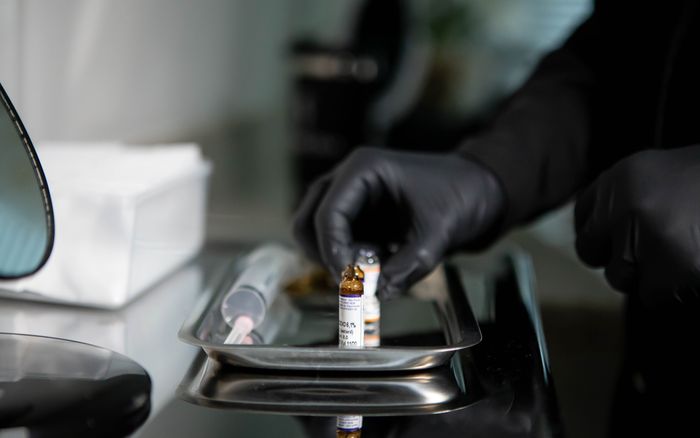
- Swab the rubber septum with alcohol and let it dry. The drying is not a waiting step, it is the disinfection — alcohol needs contact time to work, and wiping it away immediately accomplishes very little. This is the step most often skipped and the one that matters most.
- Never touch the needle, the face of the stopper, or the inside of any cap. Anything contacting the solution stays untouched.
- A fresh needle for each puncture. Coring and blunting both introduce problems.
- Only bacteriostatic or sterile water for injection. Never tap, filtered or bottled water — the issue is not only sterility but endotoxin and tonicity, and none of the three are addressed by a domestic filter.
- Never combine different compounds in one vial. It makes each concentration unknowable and the interaction unstudied. If something then goes wrong, you cannot tell which input caused it.
- Label the vial with contents, concentration and date. This is the single cheapest defence against the unit-conversion errors that cause real harm.
- Refrigerate after reconstitution, and treat the in-use life as short.
The rules that are real, with an overstated reason
Directing the stream down the glass wall rather than onto the cake. This is genuine pharmacy practice and worth doing. The reason usually given — that impact shatters the molecule — is not quite the mechanism. The actual concern is foaming and denaturation at the air-liquid interface, where proteins unfold and aggregate. Follow the practice; the apocalyptic framing is not earned.
Swirl gently, do not shake. Same reasoning, same verdict. Shaking generates foam and shear. Gentle swirling or simply waiting avoids both.
Do not freeze reconstituted solution. Reasonable as a default, though the sharper version is that freeze-thaw cycling is the damaging part. Where a product carries its own storage instruction, that instruction wins.
The rule that is actively misleading
"Check that it is clear — clear means it dissolved properly and is safe to use."
The first half is fine. Looking for undissolved cake or visible particulate is a real check, and visible particulate is a real reason to stop.
The second half is wrong in a way that matters. Clarity is not a sterility test. Bacterial contamination at clinically significant levels is typically invisible. Endotoxin is invisible. A solution can be perfectly clear and thoroughly unsafe.
It also fails in the other direction: some legitimate injectable preparations are cloudy by design. NPH insulin is uniformly milky and is supposed to be. "Cloudy therefore discard" is not a general rule, and applying it as one leads people to bin working medication while feeling responsible.
The honest position is that there is no home test for sterility. Inspect for particulate, respect the dating, keep your technique clean — and understand that passing a visual check tells you that you passed a visual check.
Sharps, and what to do with what is left
Used needles go in a proper sharps container, not household waste, where they injure the people who handle it. Pharmacies and local authorities in most places will take a full container.
Expired or suspect vials get discarded rather than rescued. The economics of doing otherwise are bad: the cost of a replacement vial is trivially small next to the cost of an injection-site abscess.
What this article does not cover
How much solvent to use for a given compound, because that determines concentration and therefore dose — a medical decision rather than a technique one. The arithmetic linking the two is in The Thousandfold Error; the numbers to put into it belong with a prescriber.
Disclosure: Biohacker Life is published by the team behind Nalu Labs, which sells in this category. Weigh our coverage accordingly.
General information about sterile technique and pharmaceutical handling. Not medical advice, and not a protocol. Nothing here is a recommendation to obtain or self-administer any compound. Several substances discussed in this section are prescription-only or unapproved, and legality varies by jurisdiction. If you think you are having a medical emergency, contact emergency services.