Peptide Safety, Stated Honestly
For most compounds in this category there is no human safety data at all. That is the headline, not a footnote — and it changes what a safety article can responsibly say.
Safety writing in this category tends to open by reassuring you. A typical version runs: peptides work through your body's own pathways, so they are gentler than conventional drugs, and side effects are mild and dose-dependent.
Almost every clause in that sentence is either unsupported or backwards. It is worth taking apart, because the reasoning errors in it are the ones most likely to get somebody hurt.
"Well tolerated" is a term of art
When a trial reports a drug as well tolerated, that is a specific, bounded claim: at these doses, in this population, over this duration, adverse events were recorded and did not exceed a threshold. It is a statement about a completed experiment.
For a compound with no human trials, nobody is entitled to the phrase. There is no adverse event data because no one systematically collected any.
This is the single most important thing to understand about the category. Approved peptide drugs have known risk profiles precisely because they were tested. Unapproved ones do not have better profiles — they have unmeasured ones.
The appeal to nature is not pharmacology
The claim that endogenous pathways are inherently safer inverts the actual pharmacology. Your body's signalling systems are where the most potent effects live, which is exactly why they are so tightly regulated.
Insulin is as endogenous as a molecule gets. It is also among the more common causes of fatal medication error, because the therapeutic window is narrow and hypoglycaemia kills quickly. "Your body already makes it" tells you nothing about what happens when you administer it exogenously, at a dose you chose, on a schedule your body did not.
Similarly, "dose-dependent side effects" is not reassurance. It is a description of nearly every toxic substance.
Three different kinds of risk
Risks that are documented, because trials happened. The approved GLP-1 receptor agonists have real, labelled warnings: gastrointestinal effects that are common and sometimes severe, increased gallbladder disease, a pancreatitis signal, and — for semaglutide and tirzepatide — a boxed warning regarding thyroid C-cell tumours observed in rodents, with contraindication in personal or family history of medullary thyroid carcinoma or MEN2. Delayed gastric emptying is a labelled effect.
That list looks alarming next to a compound with no warnings at all. It should read the opposite way. Those warnings exist because somebody looked.
Risks predictable from mechanism. Growth hormone secretagogues raise IGF-1. IGF-1 is a growth factor. Growth hormone therapy is contraindicated in active malignancy for exactly this reason — the concern is not that it causes cancer but that it may accelerate what is already present. Sustained GH elevation also produces fluid retention, joint pain, carpal tunnel symptoms and reduced insulin sensitivity; this is well described in the acromegaly and GH-replacement literature.
Risks that are simply unknown. For the compounds with no human trials, this is the whole category. Not "probably small" — unknown.
Contraindications worth treating as absolute
- Active or recent malignancy, for anything that raises GH or IGF-1.
- Pregnancy, trying to conceive, or breastfeeding. No adequate safety data exists for any of this.
- Under 18. Growth and endocrine development are still in progress.
- Existing diabetes on glucose-lowering medication, without prescriber involvement — see below.
- Significant cardiovascular disease, unstable angina, recent infarction, or arrhythmia.
- Personal or family history of medullary thyroid carcinoma or MEN2, specifically for GLP-1 agonists.
Interactions that actually cause emergencies
Insulin and sulfonylureas plus a GLP-1 agonist. This is the interaction most likely to put somebody in hospital. GLP-1 agonists alone rarely cause hypoglycaemia; combined with insulin or a sulfonylurea they very much can, and doses of the existing medication usually need adjusting by whoever prescribed them.
Oral medications plus anything that delays gastric emptying. Absorption timing shifts. For most drugs that is unimportant. For narrow-therapeutic-index medicines — anticoagulants, antiepileptics, thyroid replacement, immunosuppressants — it is not.
Anaesthesia. In 2023 the American Society of Anesthesiologists issued guidance on holding GLP-1 agonists before elective procedures, because delayed gastric emptying leaves residual stomach contents and raises aspiration risk under sedation. Your anaesthetist needs to know. This is a concrete, documented way that concealing use causes harm.
Sterile technique, because this part is genuinely preventable
Whatever else is uncertain here, injection-related infection is a well-understood risk with well-understood controls:
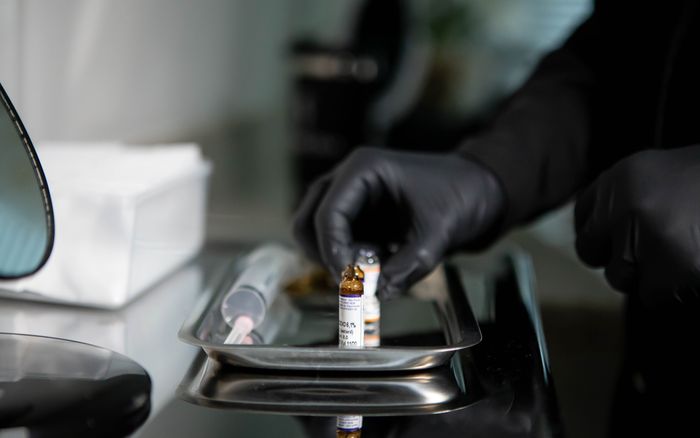
- Wash hands. Clean the work surface. Swab the vial septum and the injection site, and let the alcohol dry.
- Single-use needles, every time. Reusing a needle blunts it, damages tissue and introduces contamination.
- Never share needles, syringes or vials with anyone, for any reason.
- Rotate injection sites to avoid lipohypertrophy and scarring, which also make absorption erratic.
- Follow the storage requirements — most of these require refrigeration and protection from light, and reconstituted solutions have far shorter stable lives than lyophilised powder.
- Dispose of sharps in a proper sharps container. Not household waste, where they injure sanitation workers.
One caution that gets stated backwards: contamination is frequently invisible. A clear solution is not a sterile one, and some legitimate preparations are cloudy by design. Visual inspection is a weak test in both directions — it can catch gross problems, and it cannot clear a product.
Symptoms that mean stop and get help now
- Difficulty breathing, throat or facial swelling, widespread hives, rapid pulse — possible anaphylaxis. Emergency services, immediately.
- Severe persistent abdominal pain, especially radiating to the back, with vomiting — possible pancreatitis. Urgent assessment.
- Confusion, sweating, tremor, palpitations — possible hypoglycaemia. Fast-acting sugar, then medical evaluation.
- Spreading redness, heat or hardness at an injection site, with fever — possible cellulitis or abscess. Needs antibiotics, not waiting.
- Chest pain, severe breathlessness, fainting. Emergency assessment.
- Any rash while taking a compound with a known severe cutaneous reaction risk — stop and seek care rather than watching it.
What this article deliberately does not contain
Doses. No starting amounts, no titration schedules, no "begin conservatively and increase to tolerance."
That omission is deliberate and I want to be plain about the reasoning. Dosing guidance is the highest-risk content a publication in this position can print, and this site has a commercial interest in the category — which is exactly the circumstance in which a titration schedule should carry the least weight with you. Doses belong with a prescriber who has examined you, knows your medications and can order bloodwork.
If you find dosing protocols on a vendor's site, that is worth noticing about the vendor.
Tell your actual doctor
The highest-value safety action available to most people is unglamorous: tell the clinician who treats you what you are taking. Not a forum. Not the seller.
Concealment degrades emergency care specifically — an unexplained hypoglycaemic episode, an aspiration risk under anaesthesia, or an interaction with something newly prescribed all become harder to manage when a significant input is missing from your chart.
One honest caveat about the common advice to "find a provider experienced with peptide therapy." Sometimes that means genuine expertise. Sometimes it means finding someone who will say yes. Those are not the same thing, and the second is not a safety measure — it is the appearance of one.
Disclosure: Biohacker Life is published by the team behind Nalu Labs, which sells in this category. We have a commercial interest here, which is precisely why this piece contains no dosing guidance and why you should weigh our coverage accordingly.
This article is general information about pharmacology and drug regulation. It is not medical advice, it is not a protocol, and it is not a substitute for a clinician who can examine you and knows your history. Nothing here is a recommendation to obtain or self-administer any compound. Several substances referenced are prescription-only or unapproved, legality varies by jurisdiction, and many are prohibited in competitive sport under the WADA code. If you think you are having a medical emergency, contact emergency services.