The Thousandfold Error
The most preventable harm in this category is not pharmacological. It is a unit conversion done wrong — and the same mistake, made the same way, produces a dose a thousand times too large.

Ask a hospital pharmacist which medication errors frighten them most and you will not get an exotic answer. Near the top of every list is the same thing: a factor-of-ten or factor-of-a-thousand error in a dose calculation, made by someone competent, at speed, with the decimal point in the wrong place.
That failure mode does not require exotic drugs. It requires arithmetic under mild time pressure, which is the condition most people do arithmetic in.
This piece is about the units and the arithmetic. It is not about what numbers to put into them — that distinction matters and I come back to it at the end.
The units, and the one that causes the deaths
Milligrams and micrograms. One milligram is one thousand micrograms. This is the conversion that produces catastrophic errors, in both directions, because mg and mcg look similar written down and are frequently used in the same sentence.
Millilitres measure volume, not amount of substance. A millilitre of a solution tells you nothing about how much is dissolved in it.
International Units are defined separately for each substance, by biological activity rather than mass. An IU of one compound has no fixed relationship to an IU of another, and no general conversion to milligrams exists. If you see a conversion table treating IU as a universal unit, it is wrong.
"Units" on an insulin syringe are none of the above — and this is the misunderstanding I would most like people to lose.
Concentration is the whole game
Concentration is amount divided by volume:
concentration = mass ÷ volume
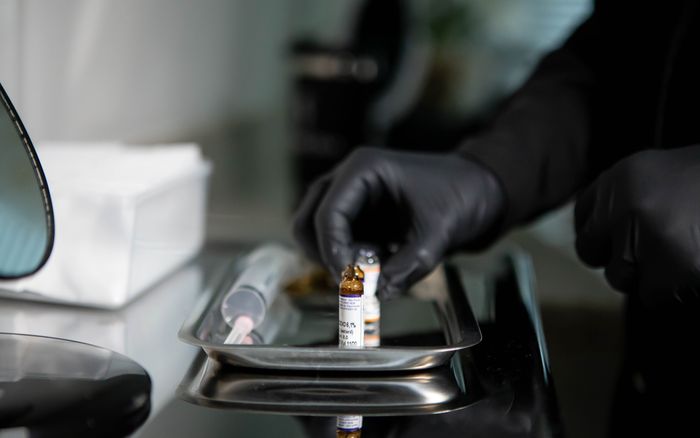
The important and slightly counterintuitive part is that when a lyophilised powder is reconstituted, the volume of solvent is chosen, not given. The vial contains a fixed mass. How much liquid goes in determines the concentration, and therefore every number downstream.
Take a vial containing 5mg, reconstituted with 2mL:
- 5mg ÷ 2mL = 2.5mg/mL
- In micrograms: 2.5 × 1000 = 2500mcg/mL
The same vial with 1mL of solvent would be 5000mcg/mL — double. Nothing about the vial changed. Only the arithmetic did.
Getting from a dose to a volume
volume = dose ÷ concentration
Suppose the concentration above (2500mcg/mL) and a specified dose of 500mcg:
- 500mcg ÷ 2500mcg/mL = 0.2mL
- On an insulin syringe: 0.2mL × 100 = 20 marks
The conversion from mL to insulin-syringe marks is just multiplying by 100 — a decimal shift of two places. Which is exactly the kind of operation that goes wrong when interrupted.
Where the thousandfold error actually enters
Almost always in one place: mixing units mid-calculation. Someone holds concentration in mg/mL, takes their dose in mcg, and divides without converting.
500 ÷ 2.5 gives 200. The correct answer was 0.2. That is a thousandfold error and the arithmetic itself was performed correctly.
The defence is procedural rather than clever: convert everything to a single unit before you divide anything. Micrograms throughout, or milligrams throughout. Never one of each.
Checking your own work
- Back-multiply. Volume × concentration should return the dose you started with. If it does not, stop.
- Ask whether the volume is plausible. These injections are typically small fractions of a millilitre. A result of 200mL is not an unusual dose, it is a unit error.
- A calculator is not a check. It faithfully computes whatever units you typed. Two independent methods, or a second person, is a check.
- Recalculate from scratch after any change — different vial size, different solvent volume, different dose. Not one of those numbers survives a change to another.
More solvent is not automatically safer
There is a genuine trade-off and it is worth understanding rather than following a rule.
Less solvent gives a higher concentration and smaller injection volumes, but each syringe mark then represents more substance — so a one-mark misread costs more.
More solvent gives a lower concentration and finer resolution per mark, but larger volumes, and a reconstituted vial has a much shorter stable life than the dry powder it came from.
The general principle from clinical practice is to choose a concentration where your intended measurement lands comfortably in the middle of the syringe's range rather than at either extreme. Marks near the very bottom of a barrel are the hardest to read accurately, and that is where misreads happen.
What this article does not give you
Numbers.
There are no compound-specific doses here, and that is deliberate. The arithmetic above is neutral — it is the same arithmetic a nurse uses, and knowing it protects you. The inputs are a different kind of thing entirely: they are a medical decision that depends on the substance, the indication, your other medications and your physiology.
This site is published by a company that sells in this category. That is precisely the circumstance in which dose recommendations should carry the least weight with you, and the reason you will not find them here. Get the numbers from a prescriber who has examined you; use the arithmetic to make sure you have not fumbled a decimal point on the way to the syringe.
One scope note: testosterone protocols come up constantly alongside this topic, and they are outside what this section covers. Testosterone is a steroid, not a peptide — a distinction we set out in Peptides, From First Principles — and it is a controlled substance whose dosing belongs with a physician rather than a formula.
Disclosure: Biohacker Life is published by the team behind Nalu Labs, which sells in this category. Weigh our coverage accordingly — and note that this is the second piece in this section that declines to print doses, for the same reason.
General information about measurement and unit conversion, not medical advice, and not a protocol. Nothing here is a recommendation to obtain or self-administer any compound. Several substances referenced elsewhere in this section are prescription-only or unapproved, and legality varies by jurisdiction. If you think you are having a medical emergency, contact emergency services.